Genesis 11:27–32 · Genesis 11 scene
Terah’s family leaves Ur
The final verses of Genesis 11 bring the long genealogy into a household the reader will follow for many chapters. Terah’s sons are Abram, Nahor and Haran. Haran fathers Lot and dies in Ur. Abram marries Sarai, while Nahor marries Milcah. The text also notes that Sarai is barren and has no child. Then movement begins: Terah takes Abram, Sarai and Lot out of Ur of the Chaldees with the intention of going to the land of Canaan. They reach Haran, settle there, and Terah dies in Haran.
What changes in this scene?
SacraScenes keeps verses 27–32 together because they establish both relationships and geography before Abram’s own call in Genesis 12. It would be easy to let later knowledge dominate the scene and present Abram as already responding to the command “Go from your country,” but that command is not narrated until the next chapter. Here Terah is the named leader of the migration. Sarai’s childlessness is also stated before the promises to Abram, which gives later developments important context. The editorial layer preserves those facts without foreshadowing them as if the characters already know what will follow.
Read it in the chapter’s flow
Genesis 12 will make Abram the central figure and begin with a direct command and promises concerning land, descendants and blessing. Genesis 11 ends one step earlier, with Terah dead in Haran and the family already displaced from Ur. That boundary matters. SacraScenes uses this closing scene as a threshold rather than blending it into Abram’s call, so the reader can see exactly where the biblical narrative changes initiative and focus. The immersive reader provides the complete Genesis 11:27–32 source range alongside this original editorial context.
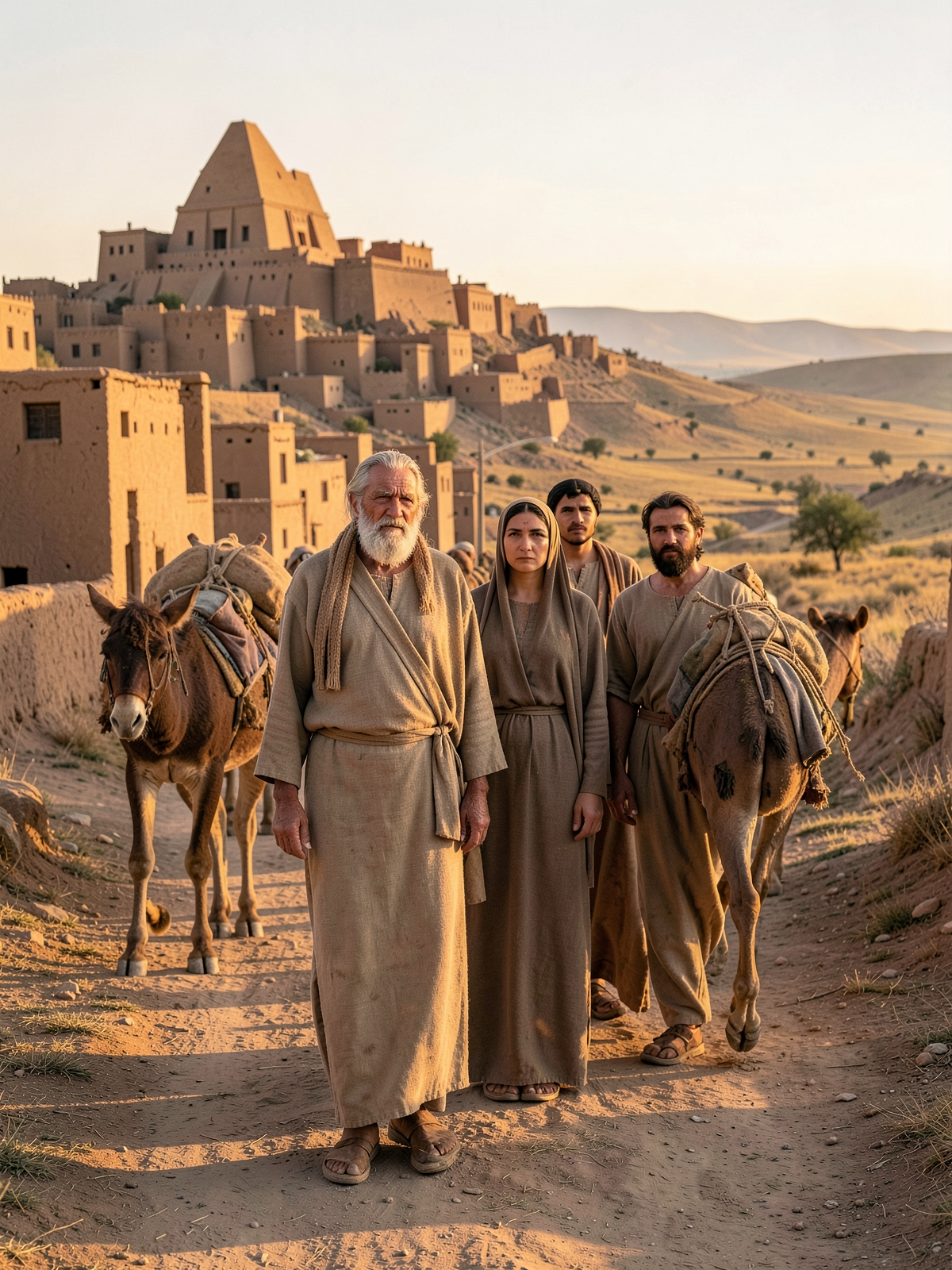
Generated SacraScenes visual interpretation for Genesis 11:27–32. It is not a photograph, archaeological reconstruction or doctrinal authority.
Why the visual is framed this way
The visual direction shows an extended family caravan leaving a substantial ancient Mesopotamian city. Elderly Terah, adult Abram and Sarai, and Lot travel with pack animals and household goods into open country. The image avoids inserting an angel, a divine voice or promised-land symbolism, because Genesis 11 does not yet describe Abram’s call. Ur is suggested through ancient urban architecture rather than identified through a modern reconstruction. The visual is about transition: a settled family becomes a traveling household and pauses in Haran.
Source boundary
The page you are reading is original SacraScenes editorial content. It explains the scene boundary, narrative movement and visual choices without presenting the commentary as Scripture. In the immersive reader, the Story panel remains separate from the Scripture panel, and the public-domain edition is named beneath the source text. This separation lets readers compare the retelling with the source instead of relying on a blended paraphrase.
For Genesis 11, the immersive reader currently uses the public-domain World English Bible (Catholic). Slovenian and German visual scenes remain unavailable until their historical Catholic source text is reviewed. See Sources for attribution and Methodology for the editorial checklist.
Open Genesis 11:27–32 in the immersive reader →Back to all 4 scenes
Editorial scene note updated 24 September 2026.