Genesis 12:4–9 · Genesis 12 scene
Abram enters Canaan
Abram responds to the call by going, and the narrative immediately makes the departure concrete. Lot goes with him; Sarai, possessions and the people attached to the household are gathered for the journey. Abram is seventy-five years old when he leaves Haran. The group reaches Canaan and passes through the land to the place of Shechem, near the oak of Moreh. There Yahweh promises the land to Abram’s offspring. Abram builds an altar, moves on toward the hill country between Bethel and Ai, builds another altar and calls on Yahweh’s name before continuing south.
What changes in this scene?
These verses form one travel scene because movement and worship alternate throughout them. The chapter does not describe a single triumphant arrival in a finished homeland. Abram enters a land where Canaanites are already present, receives a promise directed toward his offspring, pitches tents, builds altars and keeps traveling. SacraScenes avoids depicting the land as empty or automatically possessed. It also avoids turning the altars into monumental temples that would import much later architecture. The emphasis is a mobile household responding to promise through continued movement and simple acts of worship.
Read it in the chapter’s flow
Verse 10 introduces a sharp change. Instead of the promised land immediately becoming secure, famine strikes and Abram goes down to Egypt to stay there. That crisis deserves its own scene because it shifts the story from travel and altar-building to fear, deception and political vulnerability. Ending this scene at verse 9 lets the reader feel the unresolved nature of Abram’s journey: promise has been spoken, but stability has not yet arrived.
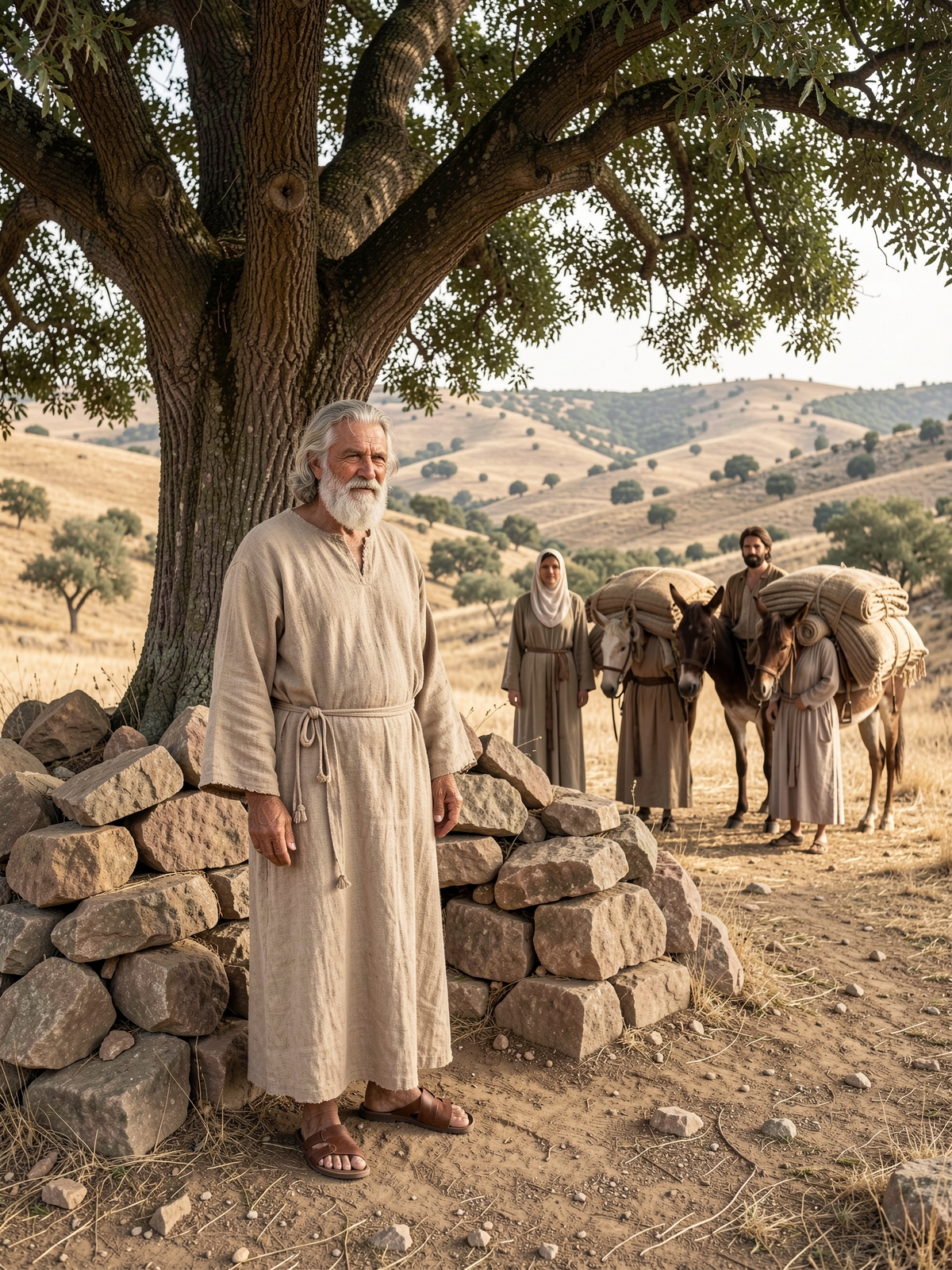
Generated SacraScenes visual interpretation for Genesis 12:4–9. It is not a photograph, archaeological reconstruction or doctrinal authority.
Why the visual is framed this way
The image uses an ancient hill-country caravan rather than a posed lineup. Abram, Sarai, Lot, household members and pack animals move through dry green-brown uplands with tents and practical belongings. A simple low altar of rough stones can sit beneath a large tree in the middle distance while Abram stands nearby. The composition should suggest Shechem and later hill-country stops without pretending to reconstruct an exact archaeological view. No human-shaped divine figure appears, and no modern roads, wagons, metal hardware or nationalist symbols are present.
Source boundary
The page you are reading is original SacraScenes editorial content. It explains the scene boundary, narrative movement and visual choices without presenting the commentary as Scripture. In the immersive reader, the Story panel remains separate from the Scripture panel, and the public-domain edition is named beneath the source text. This separation lets readers compare the retelling with the source instead of relying on a blended paraphrase.
For Genesis 12, the immersive reader currently uses the public-domain World English Bible (Catholic). Slovenian and German visual scenes remain unavailable until their historical Catholic source text is reviewed. See Sources for attribution and Methodology for the editorial checklist.
Open Genesis 12:4–9 in the immersive reader →Back to all 4 scenes
Editorial scene note updated 24 September 2026.