Genesis 13:14–18 · Genesis 13 scene
Lift up your eyes
Only after Lot has separated does Yahweh speak again to Abram. Abram is told to lift his eyes and look north, south, east and west. The land he sees is promised to him and his offspring, and the promise of descendants is expanded with the image of dust too numerous to count. Abram is then told to rise and walk through the land. The chapter closes with movement to the oaks of Mamre near Hebron, where Abram pitches his tents and builds an altar to Yahweh.
What changes in this scene?
The final scene joins promise and embodied movement. Abram is not told simply to admire a distant panorama; he is told to walk through the land. SacraScenes also keeps the closing altar in the same scene because Genesis repeatedly marks Abram’s movement through simple places of worship. The page does not visualize the promise by filling the landscape with imaginary future cities or descendants. It stays with Abram, the land before him, his tents and the altar he actually builds in the chapter.
Read it in the chapter’s flow
Genesis 14 will immediately widen the scale from household separation to regional kings, warfare and Lot’s capture. Ending Genesis 13 at the altar preserves a quiet pause before that change. It also closes a chapter whose central movement is separation without rupture: Lot chooses his direction, Abram remains, and the promise is restated after their households part.
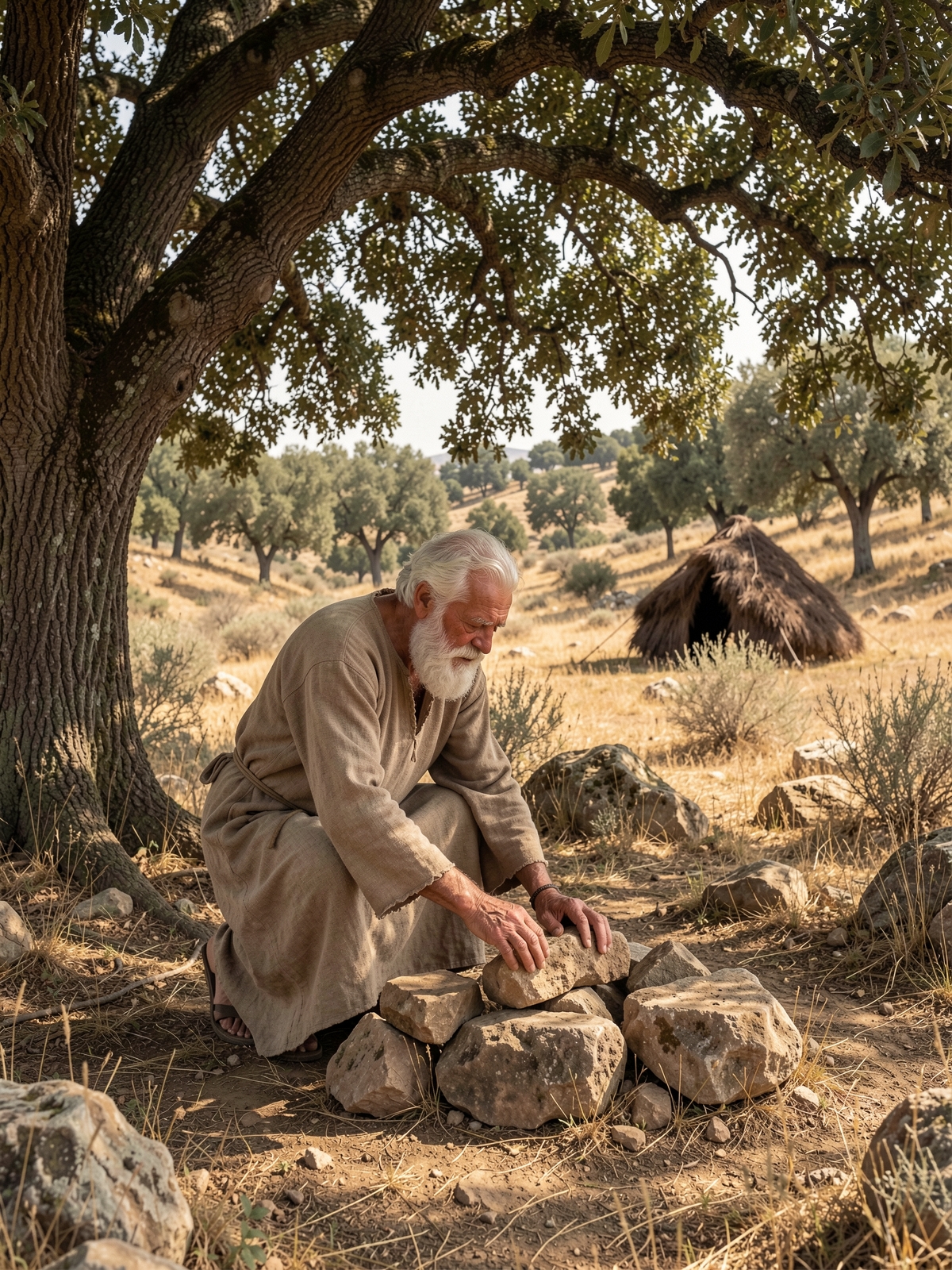
Generated SacraScenes visual interpretation for Genesis 13:14–18. It is not a photograph, archaeological reconstruction or doctrinal authority.
Why the visual is framed this way
The image uses a wide horizon and mature trees to carry the sense of renewed promise without depicting God as a human figure. Abram is elderly and active, placing a rough field stone onto a simple altar near the oaks while tents and flocks remain farther back. The land is inhabited ancient countryside rather than an empty frontier. No later temple architecture, modern tools, jewelry, wristwear, pockets or paved roads appear.
Source boundary
The page you are reading is original SacraScenes editorial content. It explains the scene boundary, narrative movement and visual choices without presenting the commentary as Scripture. In the immersive reader, the Story panel remains separate from the Scripture panel, and the public-domain edition is named beneath the source text. This separation lets readers compare the retelling with the source instead of relying on a blended paraphrase.
For Genesis 13, the immersive reader currently uses the public-domain World English Bible (Catholic). Slovenian and German visual scenes remain unavailable until their historical Catholic source text is reviewed. See Sources for attribution and Methodology for the editorial checklist.
Open Genesis 13:14–18 in the immersive reader →Back to all 4 scenes
Editorial scene note updated 24 September 2026.