Genesis 3:6–7 · Genesis 3 scene
The fruit and opened eyes
The chapter’s central choice happens quickly. The woman sees that the tree appears good for food, attractive to the eyes and desirable for gaining wisdom. She takes the fruit and eats, then gives some to the man and he eats as well. The text immediately describes their eyes as opened. Yet the first effect recorded is not triumph or mastery. They recognize their nakedness and make coverings from fig leaves. The promise of opened eyes is followed at once by a new need to hide the body.
What changes in this scene?
These two verses form one compact turning point: perception, desire, action and consequence arrive in a tight sequence. SacraScenes does not stretch the act into several artificial pages, nor does it add details about the species of fruit—the passage does not call it an apple. The editorial emphasis is on how the object is seen and chosen, followed by an abrupt change in self-awareness. That contrast is stronger when the whole movement remains together instead of splitting the eating from the fig-leaf response.
Read it in the chapter’s flow
Genesis 3:8 changes the scene again. The issue moves from self-awareness to relationship: the pair hear God in the garden, hide among the trees and answer questions about fear, nakedness and what has happened. Ending this scene at verse 7 preserves that shift. The reader can compare this original retelling with the exact English Scripture range from the World English Bible (Catholic), while the generated image is labelled as an artistic interpretation rather than a reconstruction of the event.
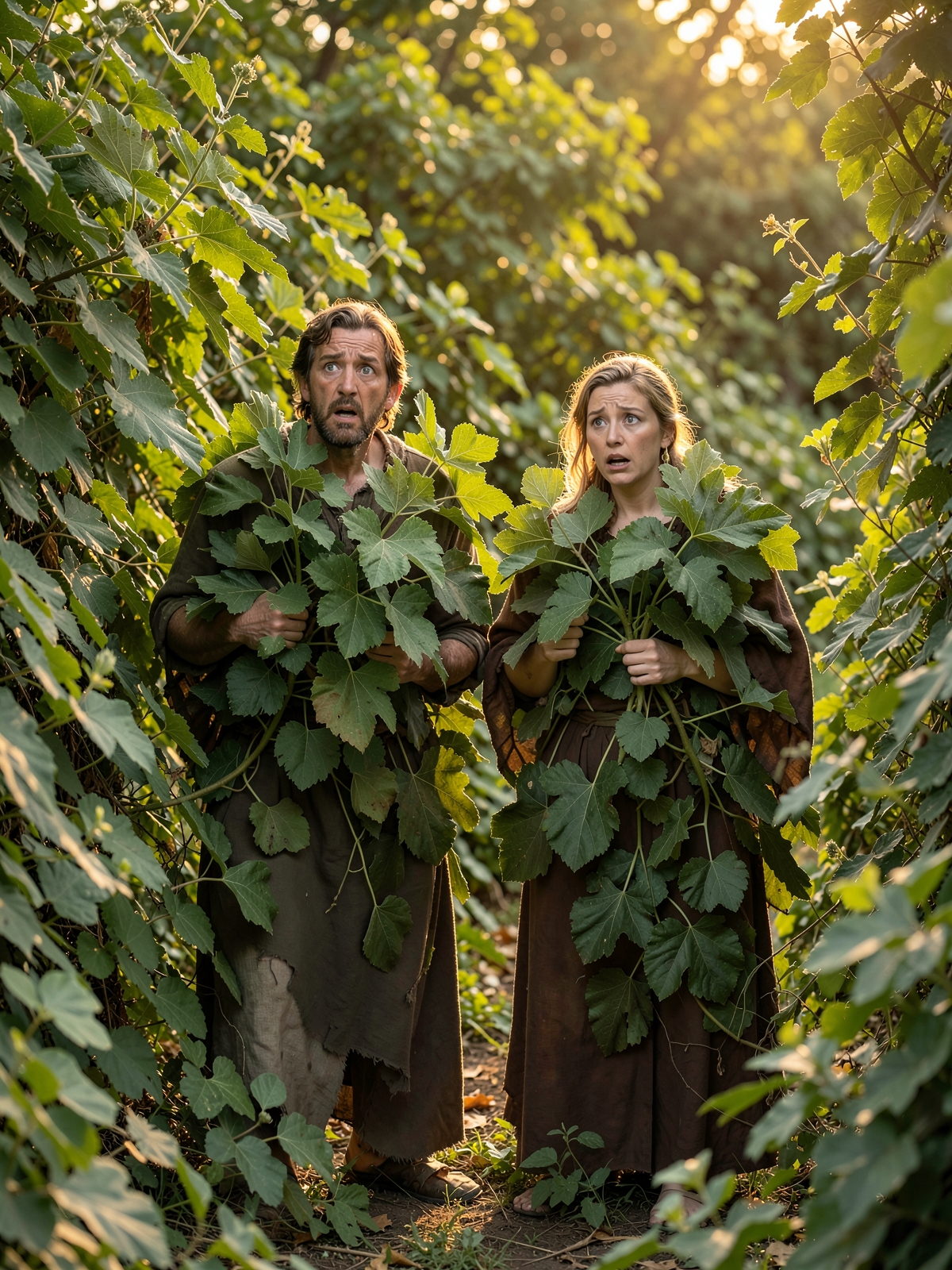
Generated SacraScenes visual interpretation for Genesis 3:6–7. It is not a photograph, archaeological reconstruction or doctrinal authority.
Why the visual is framed this way
The image direction avoids the familiar red-apple shorthand and does not turn the scene into erotic nudity. Adam and Eve are adults shown from a distance, with foliage and broad fig leaves providing complete modest coverage. Their expressions and posture can communicate surprise and discomfort without melodrama. The garden remains beautiful, because the passage has not yet described expulsion or a ruined landscape. The visual change is primarily human: what had been unashamed at the end of Genesis 2 now feels exposed and must be covered.
Source boundary
The page you are reading is original SacraScenes editorial content. It explains the scene boundary, narrative movement and visual choices without presenting the commentary as Scripture. In the immersive reader, the Story panel remains separate from the Scripture panel, and the public-domain edition is named beneath the source text. This separation lets readers compare the retelling with the source instead of relying on a blended paraphrase.
For Genesis 3, the immersive reader currently uses the public-domain World English Bible (Catholic). Slovenian and German visual scenes remain unavailable until their historical Catholic source text is reviewed. See Sources for attribution and Methodology for the editorial checklist.
Open Genesis 3:6–7 in the immersive reader →Back to all 5 scenes
Editorial scene note updated 24 September 2026.