Genesis 5:21–24 · Genesis 5 scene
Enoch walked with God
Enoch enters the genealogy with the same kind of age statement that has introduced the earlier generations, and Methuselah is named as his son. Then the language changes. Enoch is described as walking with God after Methuselah’s birth, and the phrase appears again at the end of the short section. The expected closing formula never arrives. Instead of “and he died,” Genesis says that Enoch was not, because God took him. In a chapter built on repetition, that difference is impossible to miss.
What changes in this scene?
This four-verse unit deserves a scene precisely because Genesis 5 has trained the reader to expect something else. SacraScenes does not try to explain the mechanics of Enoch being taken or turn the passage into a detailed account that Genesis itself does not provide. The editorial emphasis stays on the contrast: Enoch walks with God, and his ending is narrated differently from Adam, Seth, Enosh, Kenan, Mahalalel and Jared. Later biblical texts return to Enoch, but this page keeps its scope on what Genesis 5 itself says.
Read it in the chapter’s flow
After this brief exception, the genealogy returns to the familiar pattern with Methuselah. That return makes the Enoch unit even more distinct. Genesis 5:25–32 then moves through Methuselah and Lamech to Noah, whose name receives an explanation connected with relief from the painful work of the ground. SacraScenes therefore uses Enoch as a short visual pause inside the genealogy before the line begins turning toward the flood narrative.
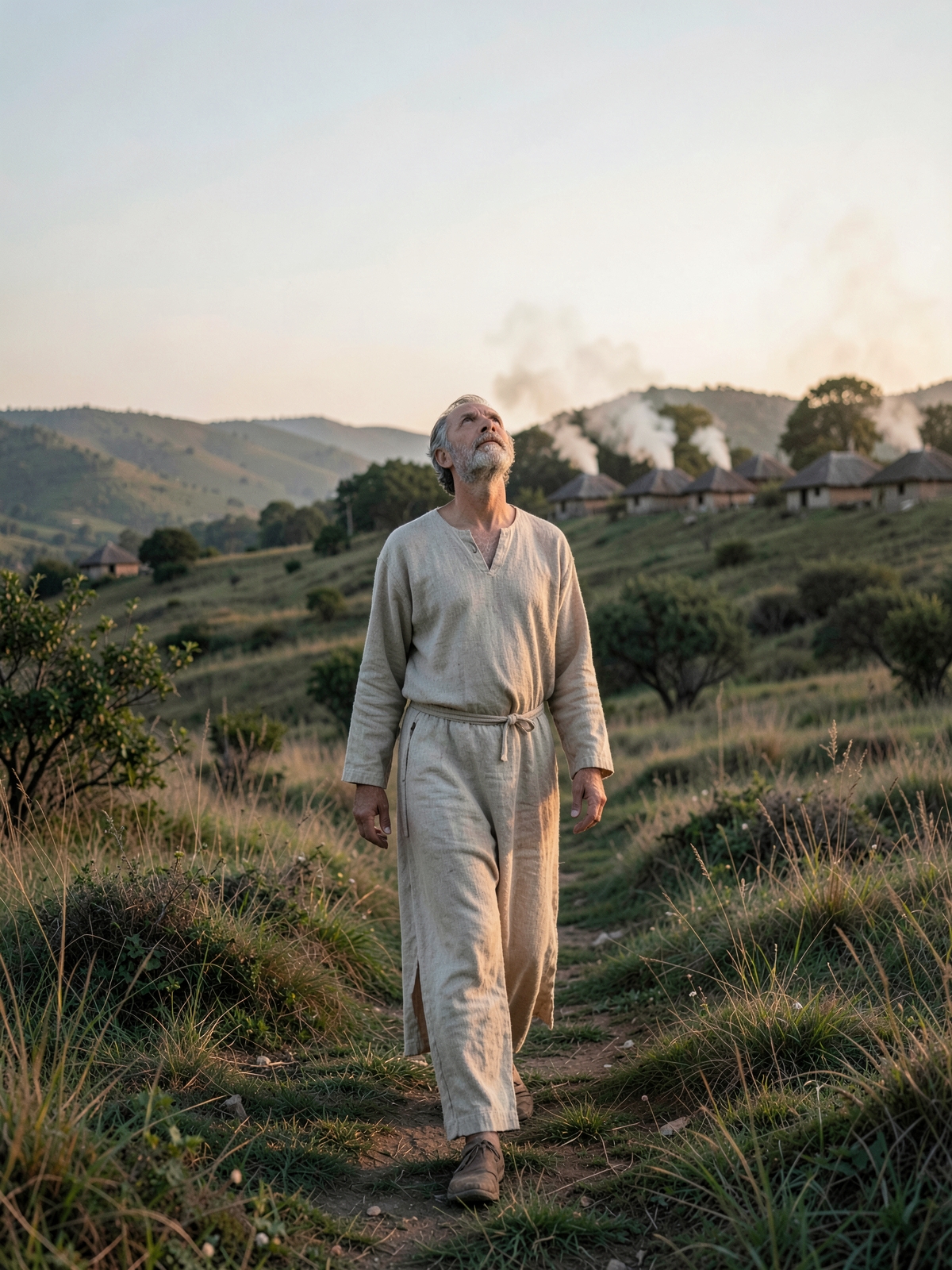
Generated SacraScenes visual interpretation for Genesis 5:21–24. It is not a photograph, archaeological reconstruction or doctrinal authority.
Why the visual is framed this way
The visual direction is intentionally quiet. Enoch can be shown as an adult walking through an early landscape at dawn, with family settlement or fields receding behind him. A prayerful or attentive posture can suggest “walking with God” without putting another figure beside him or depicting God as a human being. The scene should avoid a spectacular ascension effect because the source does not describe one. A subtle luminous horizon is enough to distinguish the image from the broader generational scene without pretending to reconstruct how Enoch was taken.
Source boundary
The page you are reading is original SacraScenes editorial content. It explains the scene boundary, narrative movement and visual choices without presenting the commentary as Scripture. In the immersive reader, the Story panel remains separate from the Scripture panel, and the public-domain edition is named beneath the source text. This separation lets readers compare the retelling with the source instead of relying on a blended paraphrase.
For Genesis 5, the immersive reader currently uses the public-domain World English Bible (Catholic). Slovenian and German visual scenes remain unavailable until their historical Catholic source text is reviewed. See Sources for attribution and Methodology for the editorial checklist.
Open Genesis 5:21–24 in the immersive reader →Back to all 4 scenes
Editorial scene note updated 24 September 2026.