Genesis 9:24–29 · Genesis 9 scene
Noah’s words and his final years
Noah wakes from the wine and learns what his younger son has done. His response names Canaan in a curse and then speaks blessing in relation to Shem and Japheth. The passage is terse and difficult, and the fact that Canaan is named matters: the text does not simply say “a curse on Ham.” After the family pronouncements, the narrative moves forward in time. Noah lives three hundred fifty years after the flood, reaches a total of nine hundred fifty years and dies.
What changes in this scene?
SacraScenes keeps verses 24–29 together because the words over the family and the record of Noah’s death close the chapter and his personal narrative arc. The editorial layer does not translate the passage into modern racial categories, does not assign skin colors to the brothers and does not treat it as a warrant for enslaving any people. Those ideas are not supplied by this scene. The page stays with the names and relationships Genesis actually gives: Canaan, Shem, Japheth and Noah at the end of his life.
Read it in the chapter’s flow
Genesis 10 will move away from Noah as the central individual and trace the descendants of Shem, Ham and Japheth into peoples and territories. Ending Genesis 9 with Noah’s death makes that transition clear. The flood story has moved through preservation, covenant and a final family rupture; the next chapter broadens the lens again to the post-flood human world. Readers can open the immersive reader for the exact World English Bible (Catholic) source text beside this original SacraScenes commentary.
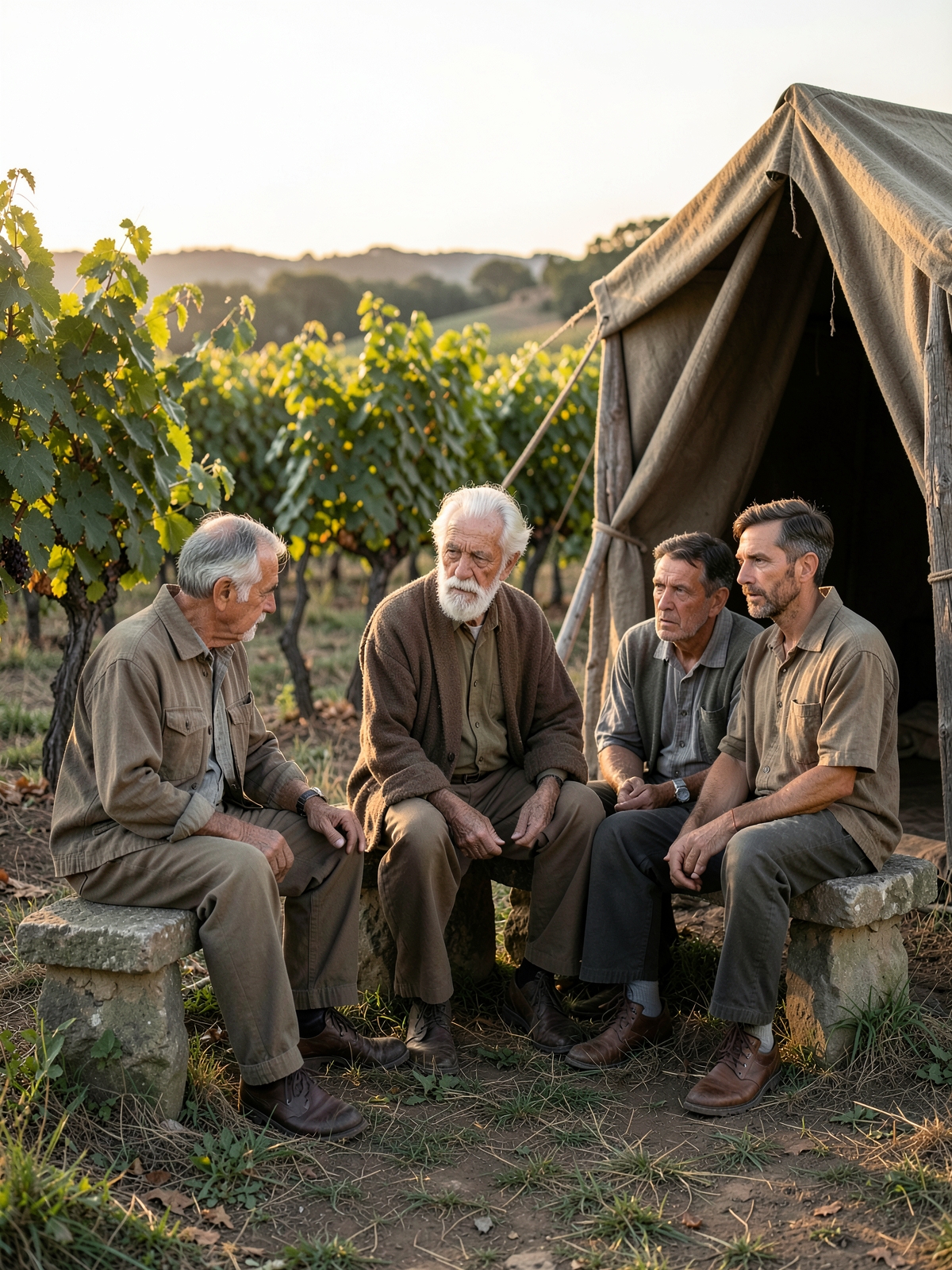
Generated SacraScenes visual interpretation for Genesis 9:24–29. It is not a photograph, archaeological reconstruction or doctrinal authority.
Why the visual is framed this way
The visual avoids both humiliation and racial coding. An elderly Noah is shown awake in a solemn conversation with his three adult sons near a vineyard and tent, every figure rendered with equal dignity and without exaggerated ethnic markers. No servant or enslavement tableau is shown. The image cannot responsibly turn a short ancient pronouncement into a literal picture of later peoples. Its purpose is simply to communicate a difficult family aftermath and the late-life closing of Noah’s story.
Source boundary
The page you are reading is original SacraScenes editorial content. It explains the scene boundary, narrative movement and visual choices without presenting the commentary as Scripture. In the immersive reader, the Story panel remains separate from the Scripture panel, and the public-domain edition is named beneath the source text. This separation lets readers compare the retelling with the source instead of relying on a blended paraphrase.
For Genesis 9, the immersive reader currently uses the public-domain World English Bible (Catholic). Slovenian and German visual scenes remain unavailable until their historical Catholic source text is reviewed. See Sources for attribution and Methodology for the editorial checklist.
Open Genesis 9:24–29 in the immersive reader →Back to all 4 scenes
Editorial scene note updated 24 September 2026.