Genesis 10:1–5 · Genesis 10 scene
Japheth’s branches spread
Genesis 10 opens as a family record after the flood. Noah’s sons are named again, and the genealogy begins with Japheth. His sons and grandsons appear in a compact sequence before the passage steps back and describes a broader result: people spreading into coastlands according to their lands, languages, families and nations. SacraScenes keeps the entire section together because the movement from names to geographic and linguistic spread is more meaningful than turning each ancestor into an isolated profile.
What changes in this scene?
The chapter is often called the “table of nations,” but that label can tempt readers to force the ancient names into a modern racial or political map. This page avoids that move. Genesis gives a post-flood genealogy and uses categories such as family, language, land and nation. Some names have historical and geographic associations, but SacraScenes does not claim that every listed ancestor maps neatly onto a current country or ethnicity. The editorial focus is the text’s own pattern: one family line branches, communities spread, and human geography becomes more complex.
Read it in the chapter’s flow
Verse 6 begins the line of Ham, and that section quickly pauses over Nimrod in a way the opening genealogy does not. The next scene therefore has a different character: names are still important, but the text suddenly describes a mighty man, hunting and the beginning of a kingdom associated with cities in Shinar. Ending this first scene at verse 5 preserves the chapter’s own shift from Japheth’s branching families to the more narrative treatment that follows.
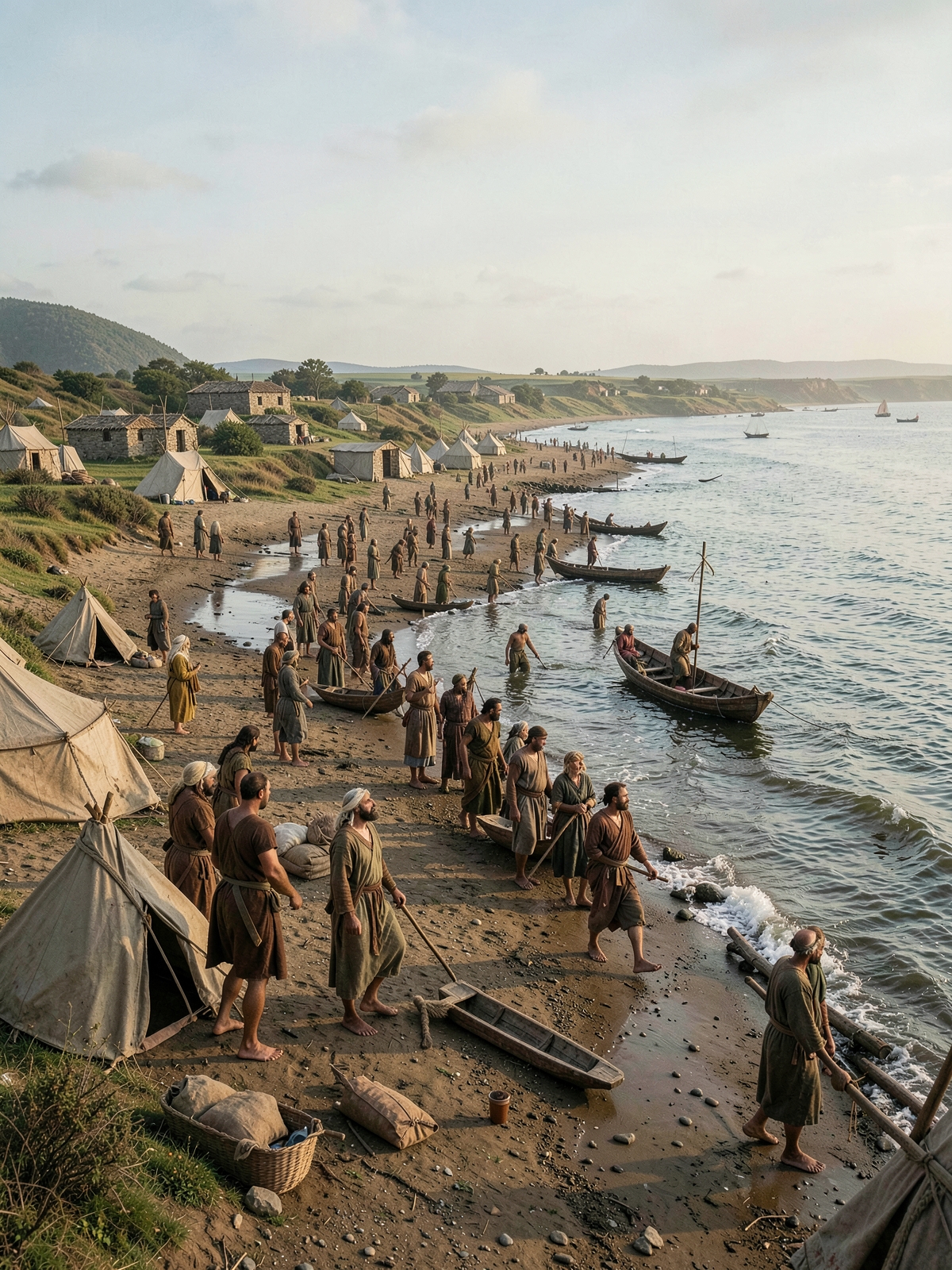
Generated SacraScenes visual interpretation for Genesis 10:1–5. It is not a photograph, archaeological reconstruction or doctrinal authority.
Why the visual is framed this way
The visual direction shows extended ancient families establishing coastal and island-side settlements, with simple boats, paths, tents and early dwellings. It does not include modern borders, national flags, labeled maps or exaggerated physical traits intended to code specific present-day ethnic groups. The people can be visibly varied as any extended human population would be, but no face or skin tone is used as a theological key to the genealogy. The image’s job is to communicate movement and settlement, not to solve ancient ethnography through visual shorthand.
Source boundary
The page you are reading is original SacraScenes editorial content. It explains the scene boundary, narrative movement and visual choices without presenting the commentary as Scripture. In the immersive reader, the Story panel remains separate from the Scripture panel, and the public-domain edition is named beneath the source text. This separation lets readers compare the retelling with the source instead of relying on a blended paraphrase.
For Genesis 10, the immersive reader currently uses the public-domain World English Bible (Catholic). Slovenian and German visual scenes remain unavailable until their historical Catholic source text is reviewed. See Sources for attribution and Methodology for the editorial checklist.
Open Genesis 10:1–5 in the immersive reader →Back to all 4 scenes
Editorial scene note updated 24 September 2026.