Genesis 10:13–20 · Genesis 10 scene
Mizraim and Canaan’s lines
Genesis 10 continues with descendants of Mizraim, naming several peoples in rapid succession. The text then turns to Canaan’s descendants and gives more geographic detail than a simple family list would require. Ancient places and boundaries are named, moving the reader from ancestry into territory. The section ends with a summary that these are Ham’s descendants according to families, languages, lands and nations. SacraScenes treats the whole block as one unit because its purpose is cumulative: genealogy expands into a populated landscape.
What changes in this scene?
This is another place where later history can easily overpower the actual wording of Genesis 10. Some names in the passage recur throughout the Bible, and modern discussions may try to draw direct ethnic lines from them. SacraScenes does not use this page to certify those identifications. The ancient genealogy and geography are presented as the source gives them, while uncertain continuity with present-day populations is left uncertain. The page also refuses the old misuse of Noah’s family lines as a racial hierarchy; Genesis 10 itself is organizing descendants and territories, not providing modern biological race categories.
Read it in the chapter’s flow
Verse 21 begins the final major family line, the descendants of Shem. That section is long and includes several generations, including Eber, Peleg and Joktan’s descendants, before the entire chapter closes with a summary of Noah’s families spreading into nations after the flood. Ending the current scene at verse 20 keeps Ham’s branch and its own summary intact, then lets the next scene carry the chapter to its larger conclusion.
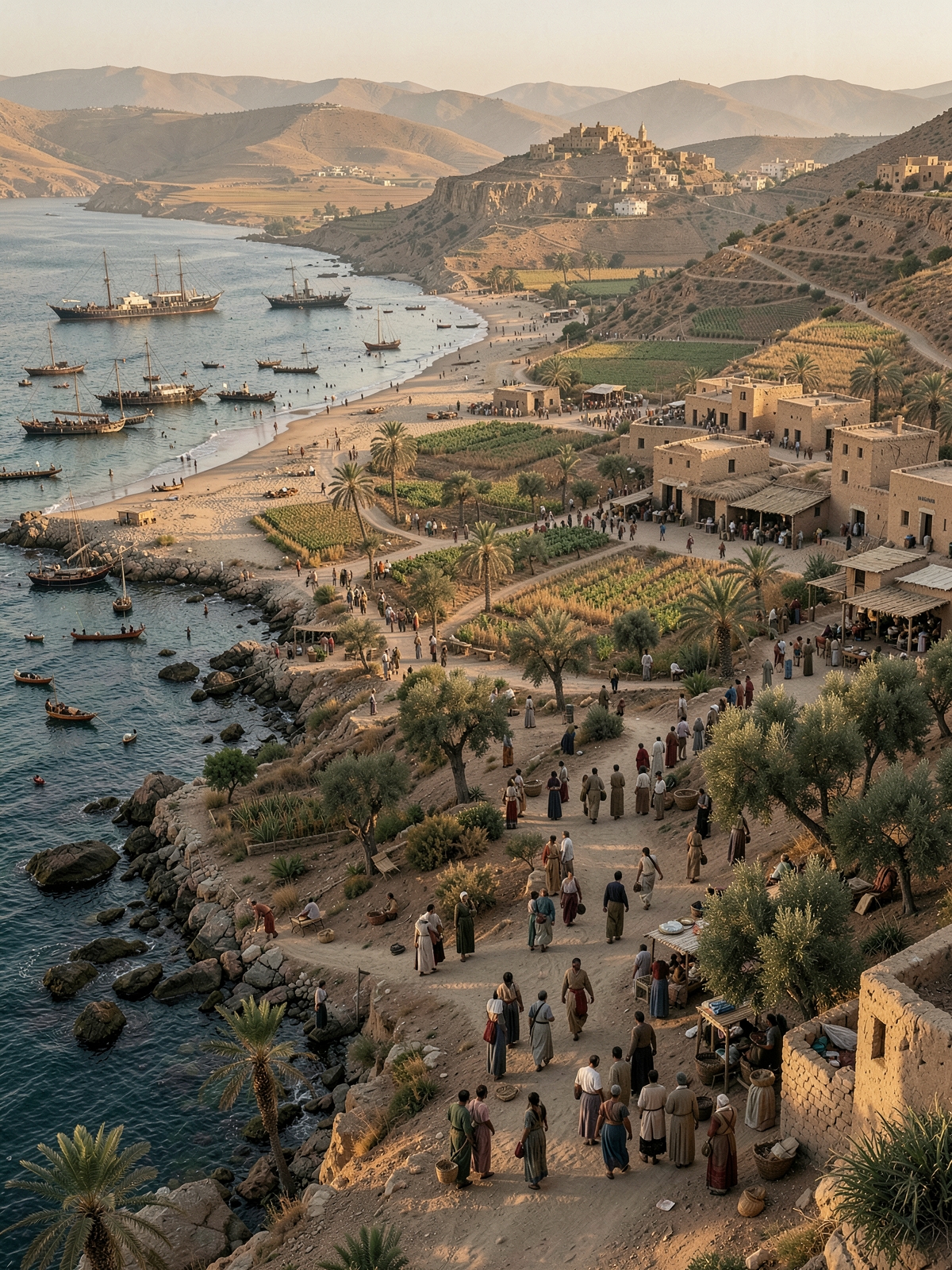
Generated SacraScenes visual interpretation for Genesis 10:13–20. It is not a photograph, archaeological reconstruction or doctrinal authority.
Why the visual is framed this way
The visual direction uses several connected ancient settlements—coastal areas, fields, hill towns and trading routes—to suggest a widening network of peoples and territories. It avoids a labeled map because a generated map would imply false geographic precision. It also avoids using costume or skin color as a code for “Mizraim,” “Canaanite” or any present-day identity. Different families can appear across varied environments, but the image remains a broad historical visualization of settlement rather than an ethnographic chart.
Source boundary
The page you are reading is original SacraScenes editorial content. It explains the scene boundary, narrative movement and visual choices without presenting the commentary as Scripture. In the immersive reader, the Story panel remains separate from the Scripture panel, and the public-domain edition is named beneath the source text. This separation lets readers compare the retelling with the source instead of relying on a blended paraphrase.
For Genesis 10, the immersive reader currently uses the public-domain World English Bible (Catholic). Slovenian and German visual scenes remain unavailable until their historical Catholic source text is reviewed. See Sources for attribution and Methodology for the editorial checklist.
Open Genesis 10:13–20 in the immersive reader →Back to all 4 scenes
Editorial scene note updated 24 September 2026.