Genesis 10:21–32 · Genesis 10 scene
Shem and the nations after the flood
The final part of Genesis 10 turns to Shem and traces several branches of his descendants. The genealogy passes through Arpachshad to Shelah and Eber, then names Peleg and Joktan and continues through Joktan’s many sons. A territorial description appears again before the chapter steps back and summarizes the entire structure. These are the families of Noah’s sons, arranged by generations and nations, and from them the nations spread on the earth after the flood.
What changes in this scene?
SacraScenes keeps verses 21–32 together because the section works as both genealogy and conclusion. Breaking every generation into separate pages would lose the chapter’s cumulative purpose and create repetitive content. Peleg’s name and the phrase about the earth being divided have attracted many later explanations, but this page does not make a speculative geological, linguistic or political theory the center of the verse. The editorial approach remains modest: preserve the genealogy, note the chapter’s summary categories and let Genesis 11 supply the next narrative about shared language and Babel in its own terms.
Read it in the chapter’s flow
Genesis 10 ends with dispersed families and nations, but Genesis 11 opens by saying that the whole earth had one language and then tells the Babel story. Readers have long discussed how the literary relationship between these chapters should be understood. SacraScenes does not force a hidden chronology into the transition. It simply preserves the chapter boundary: Genesis 10 presents the table of families and nations; Genesis 11 will narrate language, city-building and scattering in a more focused story. The immersive reader keeps the exact WEBC source text beside this editorial framing.
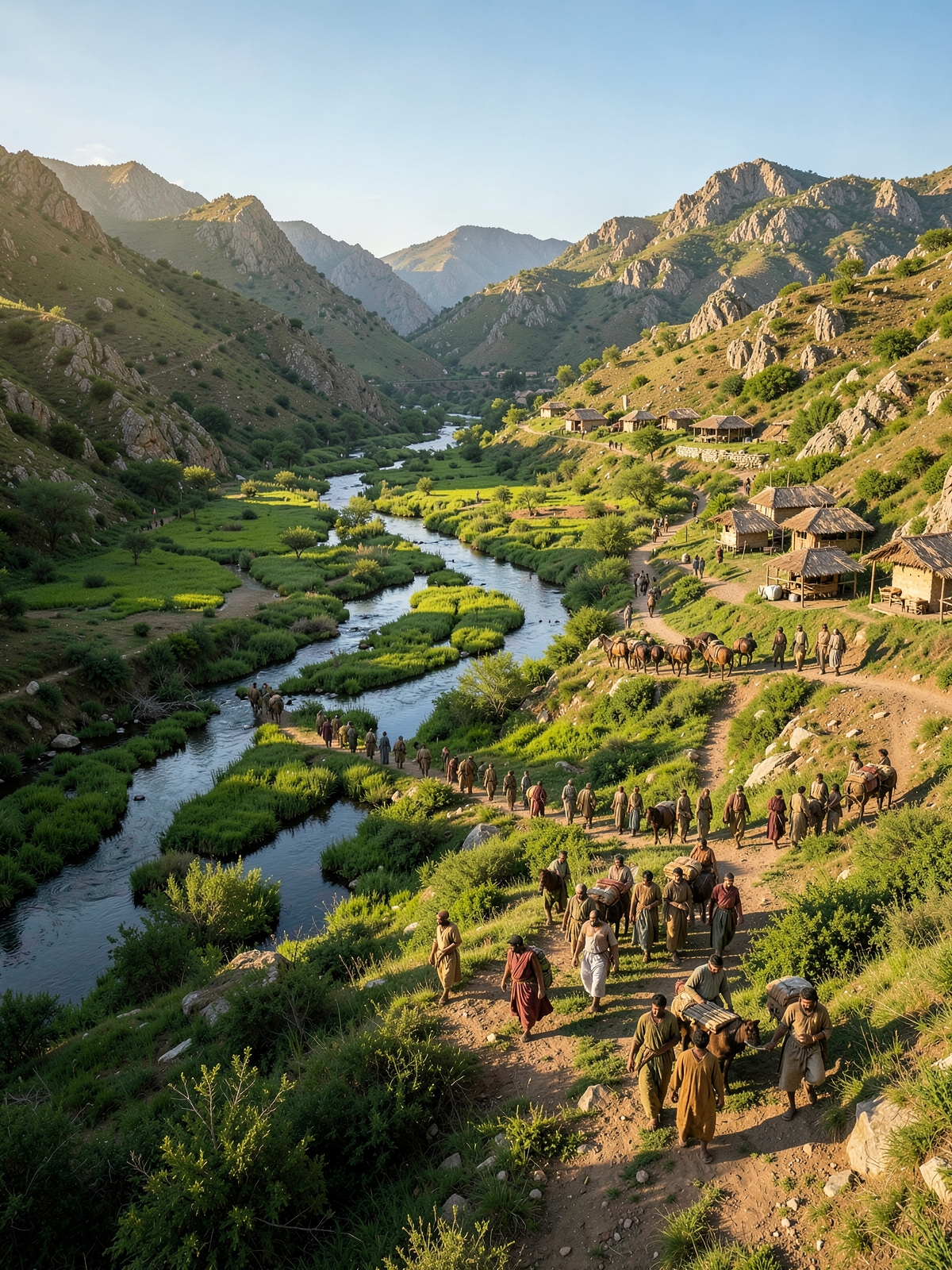
Generated SacraScenes visual interpretation for Genesis 10:21–32. It is not a photograph, archaeological reconstruction or doctrinal authority.
Why the visual is framed this way
The image shows multi-generational families branching along roads and river valleys toward new settlements. Paths can diverge through coastal, upland and river landscapes to make the idea of spread visible, but there are no modern borders, flags or labels. The people are not assigned fixed racial appearances according to Shem, Ham or Japheth. That choice is deliberate: the source describes families and nations in the ancient world, while a generated image cannot responsibly become a chart of modern human ancestry. The scene aims for human continuity and geographic expansion rather than classification.
Source boundary
The page you are reading is original SacraScenes editorial content. It explains the scene boundary, narrative movement and visual choices without presenting the commentary as Scripture. In the immersive reader, the Story panel remains separate from the Scripture panel, and the public-domain edition is named beneath the source text. This separation lets readers compare the retelling with the source instead of relying on a blended paraphrase.
For Genesis 10, the immersive reader currently uses the public-domain World English Bible (Catholic). Slovenian and German visual scenes remain unavailable until their historical Catholic source text is reviewed. See Sources for attribution and Methodology for the editorial checklist.
Open Genesis 10:21–32 in the immersive reader →Back to all 4 scenes
Editorial scene note updated 24 September 2026.